Sport Is One of the Last Shared Things
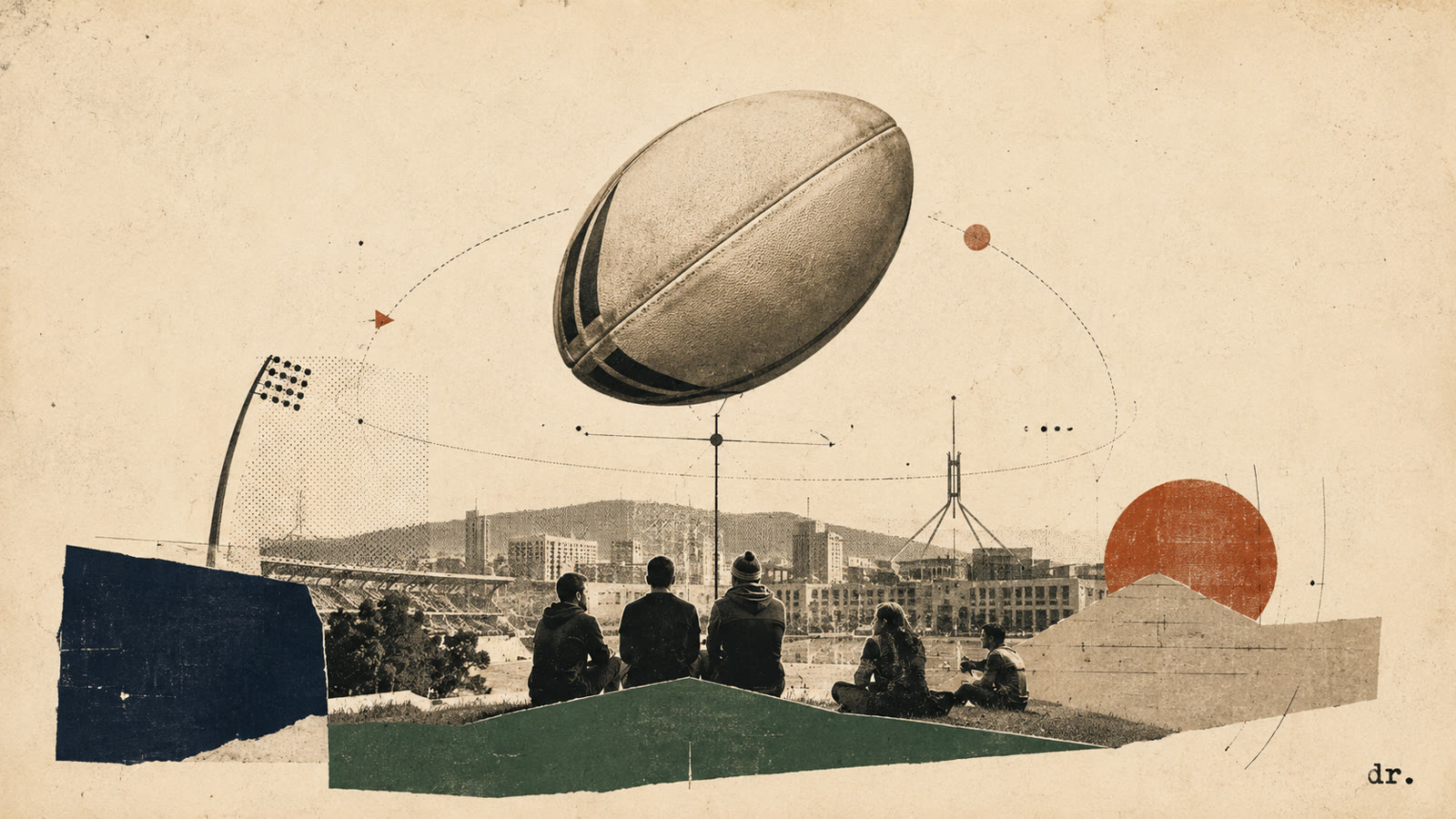
I barely followed rugby league before I moved to Canberra.
I knew enough to understand the shape of the game, but not enough to care once the television was turned off. The players were names I had heard, the ladder was something other people checked and losing part of your weekend to a refereeing decision seemed faintly ridiculous.
Then you live in Canberra for a while and the Raiders begin to seep into the place.
Not in a loud or manufactured way. More like weather.
You notice the green jerseys at the shops. Someone mentions an injury on Monday morning and everybody else already knows which one. A stranger sees your Raiders cap and starts talking as though you have both been involved in the same long-running dispute.
At first, the references pass by you. Then you learn the names, followed by the fixtures, the injuries and the increasingly complicated mathematics of the ladder. Eventually, attending a home game stops being a question and becomes an expectation.
I realised how far things had shifted after the Raiders’ home final against the Broncos. It felt like we had won the game twice before eventually losing in golden point, and the flatness was surprisingly hard to shake for the next few days.
It was an absurd amount of emotion to hand over to a football game. By then, though, the Raiders no longer felt like somebody else’s team.
I had not only become attached to the game. I had become attached to the fact that so many other people were watching it too.
The city changes around the team
Canberra is not like Sydney or Melbourne, where several clubs compete for emotional territory. There are other teams and other sports, of course, but the Raiders occupy a particular place in the city.
A one-team town gives its team civic weight.
Not everyone cares, and plenty of people would struggle to name more than two players. Still, enough people care that the team becomes part of the city’s mood. A bad loss follows people into Monday. A winning streak makes the next match feel like an appointment. During a finals run, conversations that would usually begin with work, property or politics begin somewhere else.
“How good were they?”
It is not profound, but that is almost the point. Two people who may have little else in common can begin there without needing to explain themselves first.
Sport gives people an instant “we”.
We were robbed. We cannot defend like that again. We are finally putting it together. We are going all the way.
The “we” is objectively generous. Most of us have contributed nothing beyond watching from the couch and developing firm views about interchange rotations. But it feels real enough because the team gives people something outside themselves to care about together.
That does not cure loneliness or repair a fractured society. It would be silly to ask that much of a football team. It does create small bridges, though, and small bridges are not nothing.
Part of following a team is also watching its character form over time. Every team develops a story about itself: resilient, arrogant, cursed, rebuilding, or prone to giving up somewhere around the 62nd minute.
Those stories are not always fair or accurate, but they change how you watch. When the game tightens, you are not only looking for skill. You are watching to see who wants the ball, whether the team fractures under pressure and who people become when the plan stops working.
Sport makes character visible in real time. There is nowhere to hide behind a values statement when everyone is exhausted and the score is level.
What gathers around the game
The longer I followed the Raiders, the more I realised that the result was only part of what kept people returning.
The result matters, sometimes far more than it should. But much of the value sits around the game rather than inside it: the message thread before kick-off, the walk towards the ground among people wearing the same colours, the family ritual that survives changes in jobs and houses, or the friend you mostly hear from during the season but who still feels present because the season always comes back.
It is also the stranger beside you becoming briefly familiar because you both saw the same impossible thing happen.
For a few seconds, the usual distance between people disappears. Everyone stands at once. The whole ground moves together from certainty to disbelief and then, if things go well, to joy.
Most of modern life runs in the opposite direction. Our feeds, entertainment, work and opinions are increasingly customised. We can spend the same day in the same city while inhabiting almost completely different realities.
Sport asks something simpler: be here at the same time, watch the same thing and hope for the same outcome.
There is no perfectly rational case for caring as much as people care about it, and that is fine. A life made entirely of rational attachments would be efficient and unbearable.
Sport gives adults permission to hope, overreact, feel disappointed and return the following week. It lets us participate in a story while having almost no control over how it ends.
You cannot optimise your way to a premiership from the couch. You can only show up, watch and care, then do it again next week.
That uncertainty is not a flaw in the experience. Without the possibility of disappointment, hope would not mean very much. The Broncos final made that painfully clear.
The same feeling can stretch well beyond a city. You see it when a club finally wins something or a country goes deep into a World Cup: streets fill, strangers embrace and people who have not watched a match in years suddenly develop detailed tactical opinions.
Sport can become tribal in ugly ways. It can attach itself to money, politics, ego and violence, and there is no need to romanticise all of it. But those moments still reveal how hungry people are to feel something together.
For a little while, the memory belongs to everyone.
The room is still open
I did not move to Canberra expecting rugby league to become part of how I understood the city, but somewhere along the way it did.
The Raiders are not simply entertainment now. They are a thread through the place: a mood, a ritual, a shared complaint department and a small civic religion with better jerseys.
What surprised me was not that I learned to enjoy rugby league. It was that caring about the Raiders made Canberra feel more like somewhere I belonged.
Following them has also changed what I think sport is for. It remains one of the few places where attention gathers at scale, where emotion is communal rather than personalised and where people can become part of something before explaining their entire worldview.
I suspect that will become more valuable.
We are moving towards a world in which almost anything we want to watch, read or hear can be generated quickly and increasingly for us alone. There will be no shortage of content. What may become scarce is the feeling of watching something genuinely uncertain at the same time as everyone else.
Live sport has that built in. Nobody knows the result, nobody gets a personalised ending and, for a few hours, the experience belongs to everyone watching it.
A team gives a city something to point towards and call ours. A season provides rhythm, and a match gives strangers a reason to speak.
The more the world produces for each of us individually, the more valuable the things we experience together may become.
Sport still opens that room.
The game may be irrational, but the connection is real.